
Brokerage screens and market notes borrow one alphabet for two different jobs. Alpha and beta belong to portfolios. Delta, gamma, theta, vega and rho belong to option prices.
The mix-up is easy to make. A commentary says "the Greeks," and the next sentence mentions alpha. The letters are old. The models are not the same.
This page is education, not investment, tax or trading advice. A letter on a screen does not say whether a holding belongs in a FIRE portfolio.
What is alpha in investing?
Alpha is the return left after a chosen benchmark is subtracted. In a made-up year, a portfolio return of 8% and a benchmark return of 6% leave a simple gap of 2 percentage points. That gap is active return. It describes that past window only.
Jensen's alpha goes one step further and adjusts for beta. One usual way to write it is α = (Rp − Rf) − β × (Rm − Rf). Rp is the portfolio return, Rm is the market return, Rf is the risk-free rate, and β is beta. Jensen's 1968 paper introduced this measure for mutual-fund performance. Sharpe's 1964 paper is the source of the CAPM link between beta and expected excess return. A positive alpha in one window is not evidence that the result will repeat, and the formula does not separate luck from skill by itself.
Alpha is not an option Greek. An option chain can show a large delta on a day when a fund report shows a negative alpha. The two numbers answer different questions.
What is beta in investing?
Beta measures how strongly a stock or portfolio has moved with a chosen market. The usual sample formula is β = Cov(Ri, Rm) / Var(Rm). Ri is the asset's return, Rm is the market return, Cov is their covariance, and Var(Rm) is the variance of the market return.
A beta of 1 means the asset moved one-for-one with that market in the sample. A beta of 1.2 means a 1% market move lined up, on average, with about a 1.2% asset move, before the asset's own idiosyncratic return. Those sentences define the statistic. They are not a promise for next month. The benchmark, the window and the return frequency all change the number.
Beta is co-movement, not a quality score. A higher beta scales the market's swing. It does not say the business is safer, or that the manager was more skillful. Diversification can shrink the damage from one company. It does not remove beta, because the shared market factor remains. A broad index fund is built to land near a beta of 1 against its own index, before fees and tracking difference.
How do option Greeks differ from alpha and beta?
Option Greeks estimate how an option's price changes when one input moves and the others stay fixed. Cboe's glossary describes that family as sensitivities to the underlying price, the change in that sensitivity, time decay, implied volatility and interest rates. Alpha and beta are not on the list.
The shared alphabet causes the mix-up. Alpha and beta compare returns. Delta, gamma, theta, vega and rho are slopes of an option price. Listed U.S. equity options are usually American, so the holder may exercise before expiry. A Cox–Ross–Rubinstein binomial tree prices that contract by checking exercise at every step. Black and Scholes (1973) set out the European closed form and the share hedge that offsets the option's exposure to the share price. That formula is the benchmark beside the tree, and it matches an American call only when early exercise is worth nothing, such as a call on a share that pays no dividend. A brokerage can display the slopes for a listed contract even when the investor never trades them.
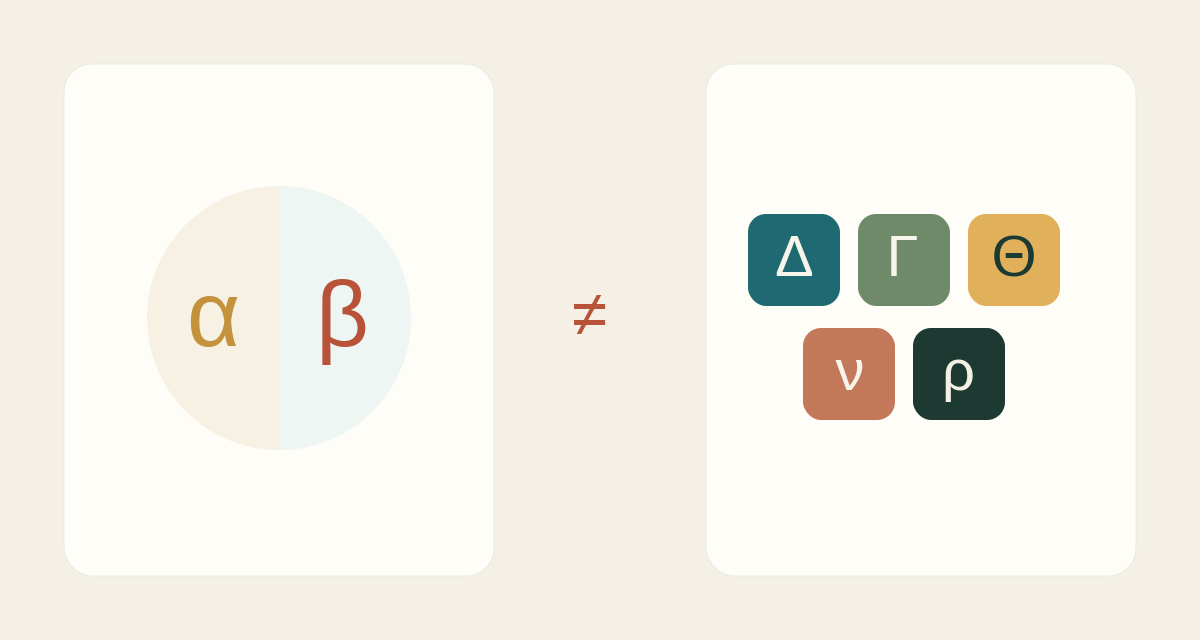
People still bundle every letter under "stock Greeks." That bundle is a habit of speech. A reader can keep the two families apart and still understand both the fund report and the option chain.
What does delta say about a call option?
Delta is the estimated change in the option price for a $1 change in the underlying, with the other inputs held fixed. Cboe states that call deltas are positive and put deltas are negative. For an ordinary equity call, delta lies between 0 and 1. For an ordinary equity put, it lies between −1 and 0.
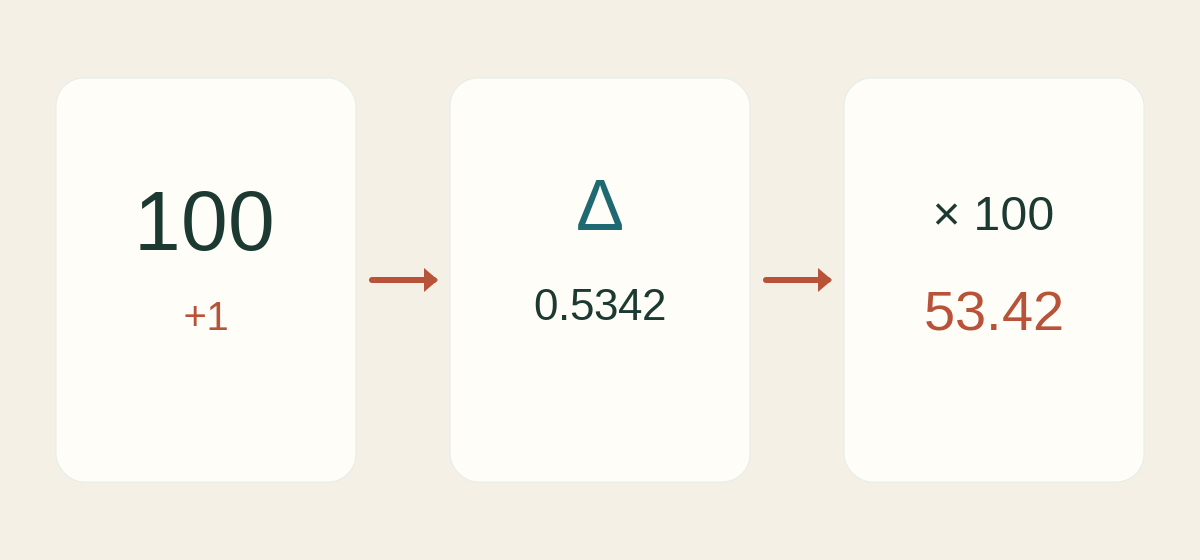
These figures are the simulator's opening American call, not a live quote: a $100 share, a $100 strike, 30 days, 20% volatility, a 4% rate and no dividend. The 300-step tree prices that call at $2.45, with delta 0.5342, about $53.42 on a 100-share contract. With no dividend, the European Black–Scholes premium rounds to $0.00. Gamma changes that delta on the next $1 move. The bid-ask spread sits outside the slope.
A plain introduction to the contract, before any Greek, is the SEC's options investor bulletin. The OCC's risk disclosure covers the obligations behind listed options. Expiration payoffs are a separate picture: the FIRE options guide walks through calls, puts and covered positions, and the payoff calculator shows value at expiration. Delta is a model slope along the way, not that expiration diagram.
What do gamma and theta measure?
Gamma is the estimated change in delta for a $1 move in the underlying. Cboe defines it that way. In that same American call, a gamma of 0.0695 takes the delta of 0.5342 to about 0.6037 after a $1 rise, before any other input changes. Those two slopes come from the same 300-step tree. Gamma is often larger when the strike is near the share price and expiration is closer. Far from the strike, delta is already near 0 or 1 and has less room to move. A long call or long put has positive gamma. The seller has the opposite sign.
Theta is the estimated change in the option price as time to expiration decreases, with the share price and implied volatility held fixed. Cboe expresses theta as a negative number, because a long call or a long put tends to lose time value as expiration approaches. The seller of that option has the opposite position exposure: the seller receives the time value the buyer loses, and still carries the contract's other risks. Theta is not a daily coupon. A large share move, or a jump in implied volatility, can outweigh one day of time decay.
What do vega and rho measure?
Vega is the estimated change in the option price for a 1 percentage-point change in implied volatility, with the share price and time held fixed. Cboe defines vega on a 1% volatility change, which in this setting means one volatility point, such as 20% to 21% in an illustration, not a live quote. The name is not a Greek letter. Some formulas use the Greek letter nu, ν, for the same slope. A long option usually has positive vega, because a higher implied-volatility input raises the model price when the other inputs stay put.
Implied volatility is the volatility number that, inside a pricing model, matches the option's market price. Here the model is a binomial tree, and a Black–Scholes quote is only the European benchmark. Cboe describes it as the forward-looking figure implied by that price. It is not the historical standard deviation of the share, and it is not a forecast an investor has to adopt.
Rho is the estimated change in the option price for a 1 percentage-point change in the risk-free rate. Cboe defines rho on a 1% rate change. Read that 1% as one percentage point in a textbook sketch, such as 2% to 3%, not as today's policy rate. For many short-dated equity options, rho is small beside delta and vega. It matters more when the contract is long-dated, including LEAPS, because the rate has longer to act inside the model. Rho is not a prediction of the next central-bank meeting.
Names such as vanna and charm describe smaller, second-order slopes. The screens most long-term investors meet stop at delta, gamma, theta, vega and rho.
Open the Option Greeks Simulator →
Can option hedging move the stock?
Delta hedging can add share trades that amplify or dampen a move, but those trades do not identify the cause of any particular day. Consider a dealer who has sold calls and wants the combined delta near 0. If the share rises by $1, call deltas increase. The short calls become a larger negative-delta exposure, so staying near neutral can mean buying more shares. If the share falls, the hedge can mean selling shares. That pattern can amplify a move already underway. A dealer who is long gamma can trade the other way, selling into strength and buying into weakness, which can dampen a move.
Whether either flow is large depends on open positions, how often hedges are adjusted, and how much other trading is present. Cboe's glossary defines hedging as a transaction that aims to reduce an exposure. That definition is not a measurement of one session's volume. A FIRE portfolio that holds a diversified fund does not need to trade this channel. Listed options are one reason a single day can look mechanical. They are not a reason to abandon a long plan, and they are not a signal. A drawdown checklist and the market volatility simulator ask a different question: how a spending plan meets a difficult return path.
How can a long-term investor use these letters?
A long-term investor can treat alpha and beta as labels for benchmark-relative return and market sensitivity, and can treat the option Greeks as a glossary for screens and commentary. Neither set replaces a spending plan, a diversified core, or a clear limit on losses the household can live through. A total-market index fund is built for a beta near 1 against its own index, before fees. An alpha of 2 percentage points over a short window describes that window. It is not a reason to concentrate.
Investors who sell covered calls or cash-secured puts should keep delta, theta and assignment in one conversation. Premium is not a separate yield detached from the stock. Historical fund swings are another topic. The portfolio backtest guide looks at return, volatility and drawdown. It does not price an option.
Frequently asked questions
Is alpha an option Greek?
Alpha is a portfolio measure, not one of the option Greeks. Screens use delta, gamma, theta, vega and rho for an option's price sensitivities. A report can show alpha over 3 years while the option chain shows delta. Those figures do not confirm each other, and neither says whether the shares belong in a FIRE portfolio. Check whether the report means a simple gap versus a benchmark or Jensen's beta-adjusted version.
Does a beta above 1 mean a stock is riskier in every way?
A beta above 1 means the asset moved more than the chosen market in the sample, in the same direction on average. A market drop of 20% would, on that past relationship, line up with a larger asset move before idiosyncratic return. Beta still depends on the benchmark, the window and the return frequency. It does not measure fraud, valuation or fit with a household budget. A beta near 1 is not a shelter from a falling market.
Why do stock pages show delta, theta and vega?
Brokers show those letters because listed calls and puts trade on the stock, not because the share has an option Greek of its own. Delta, theta and vega belong to the contract. On this page's American call, a delta of 0.5342 on a 100-share contract turns a $1 share move into about $53.42 of option value, with other inputs fixed. Someone who never trades options can leave the chain closed. The labels describe contracts, not a fund's expected return.
Check the sources
These references support the methods and context discussed here. Personal examples and scenario assumptions do not establish universal outcomes.
- Cboe Options Institute glossary: delta, gamma, theta, vega and rho
- Investor.gov: options investor bulletin
- OCC: characteristics and risks of standardized options
- Sharpe: Capital Asset Prices (1964)
- Jensen: The Performance of Mutual Funds (1968)
- Black and Scholes: The Pricing of Options and Corporate Liabilities (1973)