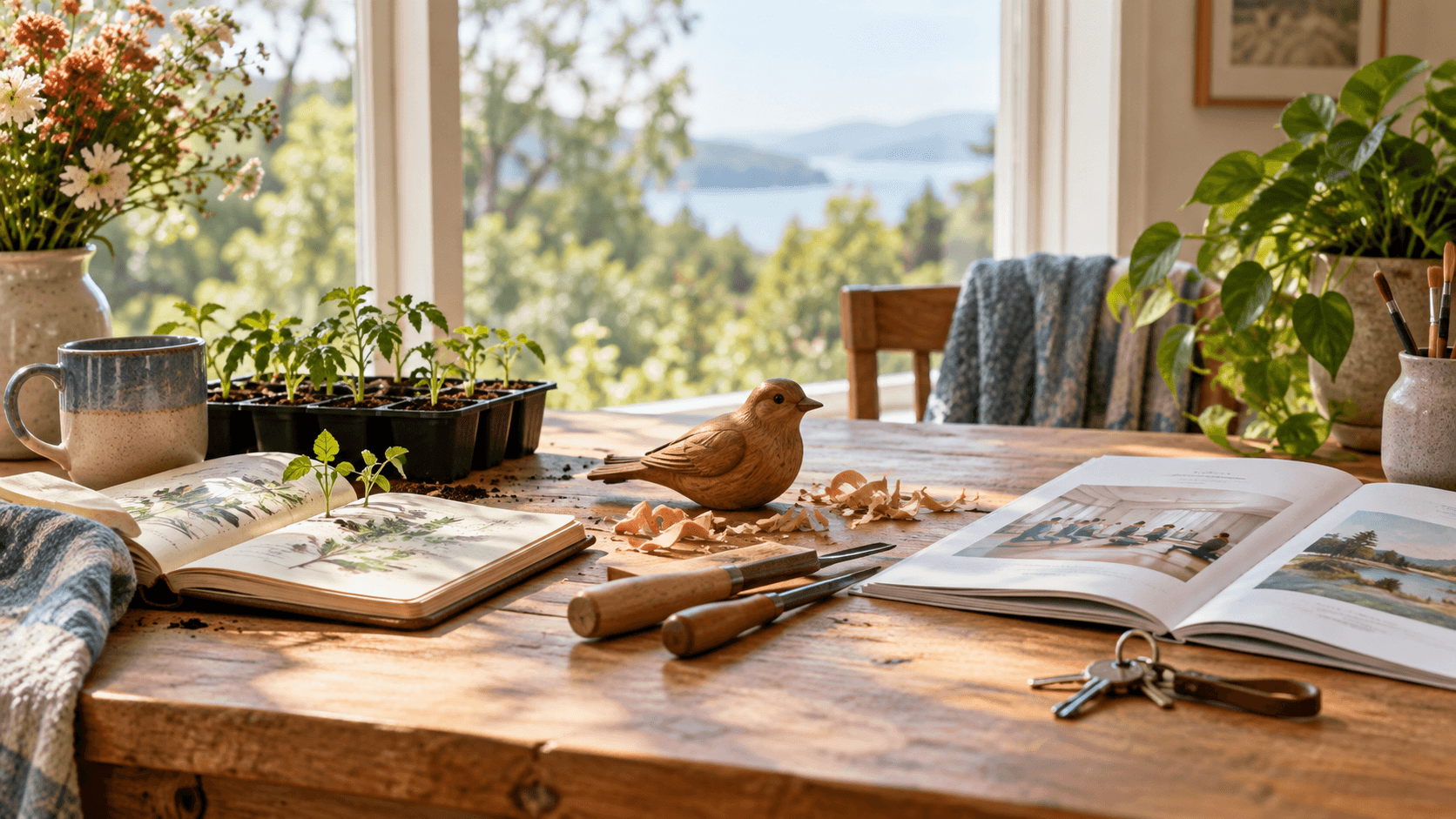
FIRE can remove the need to sell your time. It cannot tell you what a good Tuesday looks like. The people who seem most at ease after work becomes optional usually do not fill every hour; they build a few steady reasons to leave the house, use their hands, see people and feel useful.
The question comes up repeatedly in FIRE conversations: What will I actually do all day? It is an honest question. A job can be draining, political and too consuming, but it also supplies a timetable, colleagues, problems to solve and a ready-made place in the world.
The following are fictionalised composite stories, not prescriptions and not promises about what retirement should be. Their spending, locations and health are different. What they share is something more practical: each person stopped treating retirement as a blank space and began treating it as a life with texture.
Mira: the garden became a reason to keep learning
Mira reached financial independence at 61 after a long career in occupational therapy. She and her partner live in a modest home near a medium-sized city. Their portfolio covers their essential spending, they have a cash buffer, and neither needs a new career to make the numbers work.
For the first three months, Mira enjoyed doing almost nothing. She slept without an alarm, read novels in the afternoon and felt a deep relief whenever she walked past the morning commuter traffic. Then she noticed a quieter feeling underneath: the week had become too interchangeable. Saturday felt almost exactly like Tuesday.
She did not solve this by inventing a second job. She rented a small allotment ten minutes away by bicycle.
On Tuesday mornings she cycles there with a thermos, checks the seedlings, pulls weeds and talks with whoever is working nearby. In spring she starts too many tomato plants; in late summer she gives bags of beans to neighbours and learns food preservation from an older gardener. Once a month she helps a local primary-school group spend an hour outdoors. She is not the teacher. She brings spare gloves, shows children how worms change the soil, and goes home muddy and pleasantly tired.
Her week also contains unglamorous anchors: a strength class on Monday, a long walk with her sister on Thursday, one shared lunch that she and her partner protect from errands, and a Friday afternoon with no plan at all. She occasionally pays for a workshop or replaces a tool, but she no longer judges every expense by whether it produces income. The garden is not a savings strategy. It is movement, attention, seasonal change and a small circle of people who notice if she does not appear.
Mira says the best part is not growing food. It is becoming a beginner again. After decades of being competent at work, she is comfortable asking why the plum tree is unhappy or admitting that the slugs won this year. That humility has made retirement feel alive rather than finished.
Daniel: a smaller version of work, chosen on purpose
Daniel left full-time software leadership at 49. His FIRE plan was deliberately flexible: his investments cover the household's base costs, while any paid project is a choice rather than a rescue. At first he told friends he was "retired," then realised the word made people imagine a life of permanent holidays that did not suit him.
His ordinary Wednesday begins with a slow breakfast and a walk to the public library. From 10 a.m. until lunch, he helps a neighbourhood climate group make sense of its messy data: energy bills, grant applications, attendance lists, maps of homes that need insulation. He is careful about the boundary. He has one fixed morning, a clear scope, and no Slack account. When the laptop closes, it stays closed.
Two afternoons a week are for a project that may never become a business: recording short interviews with older residents about the changes they have seen in the town. He learns basic audio editing, visits people in their kitchens, and publishes the conversations on a small local site. Some weeks only thirty people listen. He still cares because the work has a shape, a craft and a real audience.
Daniel also accepts a handful of well-paid consulting days each year. He uses the income for things he genuinely values: train trips to see friends, a better winter coat, and a small fund for family adventures. But he declines projects that recreate the old pressure. The most important freedom is not the extra money. It is sending a polite no without having to calculate whether it will endanger the mortgage.
His partner noticed a difference after the first year. Daniel used to bring office urgency into every evening. Now he makes dinner most nights, learns a difficult piece of music badly and slowly, and can take a long weekday train to visit a friend who is having a hard time. His contribution did not disappear when the job title did. It became more local, more bounded and more human-sized.
Leila: friendship is part of the retirement plan
Leila is 67 and had always imagined that retirement meant travelling constantly. She did travel during her first year after leaving a finance role: long rail journeys, museum weekends, a month staying with family abroad. She loved it, but she eventually saw that a life built only around trips had a strange weakness. When she came home, no one expected to see her on Tuesday.
So she built a rhythm around people rather than destinations.
Every Monday she swims at the same quiet pool, then has coffee with two women she met in the changing room. On Wednesday she volunteers at a refugee-support kitchen, mostly chopping vegetables and listening. On Saturday morning she hosts a six-person reading group in her living room. The books are not always serious; one month they read a detective novel, another month a memoir that prompts an argument about work, children and how much ambition is enough.
Her personal project is ceramics. It began as a beginner class she nearly cancelled because the studio fee felt "unnecessary." Now she keeps a shelf of imperfect bowls at home and gives the ones she likes to friends. The point is not to become an artist. The point is to be absorbed by something that does not reward speed. A bowl collapses. The glaze surprises her. She tries again next week.
Leila still watches her spending. She chooses off-season travel, shares transport, and does not pretend that every wish deserves a purchase. But she has changed the question from "Can I justify this?" to "Does this help me remain connected, capable or curious?" A yearly studio membership costs money. So did commuting, work clothes, lunches grabbed between meetings and recovering from a week she did not enjoy. Context matters.
When a close friend became ill, Leila was able to be present: not with a dramatic gesture, but with soup, hospital visits and time. That is the form of wealth she talks about most often. FIRE did not make her life endlessly exciting. It made her available.
What these stories have in common
None of these people found a perfect retirement identity. Mira sometimes worries that her garden is a mess. Daniel occasionally takes on too much. Leila has quiet weeks when she feels lonely. FIRE does not remove grief, uncertainty, illness, family conflict or the need to make plans again.
But each of them has more than one anchor:
- movement that supports physical and mental health
- a practice that rewards attention rather than efficiency
- people who provide regular, low-pressure contact
- a way to contribute without needing to build an empire
- blank space that has not been monetised or optimised
- enough financial margin to say yes to what matters and no to what does not
That combination is often more sustaining than a dramatic bucket list. Retirement is not a performance of leisure. It is the chance to make an ordinary week feel inhabitable.
A useful question before and after FIRE
Instead of asking only, What will I stop doing when I retire?, try asking:
- Who will I see regularly when work is gone?
- What will I practise badly enough to remain a beginner?
- Where will my body move during an average week?
- What small contribution would I make even if nobody paid me?
- Which hours do I want to leave unclaimed?
The answers can change. They should. A good Level 4 life is not a rigid schedule copied from someone else. It is a responsive arrangement of health, relationships, curiosity, rest and enough purpose to make freedom feel warm instead of empty.